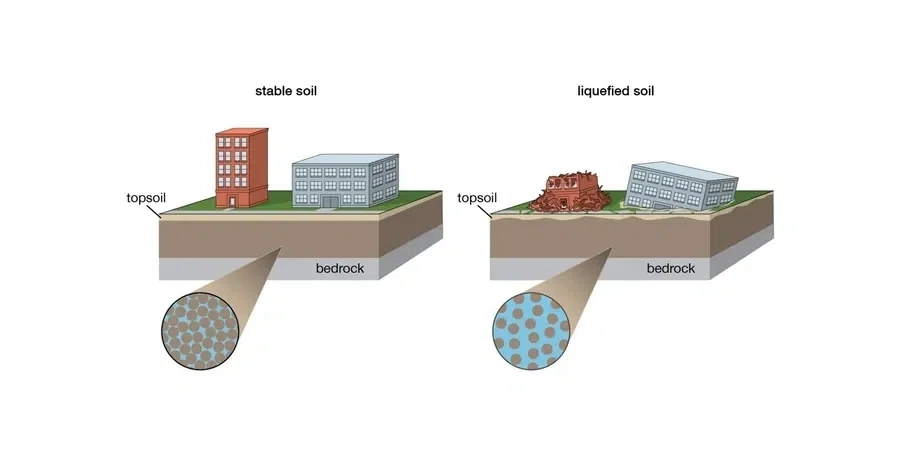
Maple Ridge grew along the Alouette River floodplain and up onto the Pitt Polder lowlands — ground that was never meant to hold dense urban weight without a fight. Much of the city sits on Holocene alluvium and organic silts that register very low blow counts in the upper 15 metres. When a Cascadia subduction event or a shallow crustal quake hits, those saturated loose sands don't just shake — they can lose effective stress entirely. We run SPT drilling to gather N-values and fines content directly from the target strata, then feed those into the NCEER/Youd-Idriss framework. For sites where undisturbed sampling is critical — like Fraser River silty sands — CPT testing gives us a continuous tip resistance and friction sleeve profile that eliminates rod energy corrections and lets us map thin liquefiable lenses that a split-spoon sampler misses.
Liquefaction isn't just sand boils — in Maple Ridge it means differential settlement that can snap sewer lines and tilt slab-on-grade foundations.
Scope of work
Every calculation ties back to grain-size curves and plasticity indices we measure in our ASTM D4318 and D6913 compliant lab, because getting the fines content wrong by just 5% can flip a site from 'low risk' to 'high risk' in the triggering charts. We also cross-check with shear-wave velocity profiles when the budget allows, using MASW surveys to capture Vs30 and detect velocity inversions that SPT alone can't resolve.
Area-specific notes
Maple Ridge sits in a moderate-to-high seismic zone, with a 2%-in-50-year PGA around 0.38g on firm ground according to the NBCC 2020 hazard maps. The real trouble isn't the peak acceleration — it's the duration. A magnitude 9 Cascadia event offshore could shake the Lower Mainland for over three minutes, and that sustained cyclic loading drains the excess pore pressure right out of loose Fraser River sands. The Alouette River corridor and the Pitt Meadows basin have mapped liquefaction susceptibility in the provincial hazard atlas, and post-event aerial photos from Christchurch and Niigata show exactly what that looks like: lateral spreads eating into setback distances, buried utilities floating upward, and lightweight structures sinking unevenly. Skipping the analysis means accepting a foundation performance that nobody can predict under the design earthquake. We run the numbers, we log the actual soil, and we tell you where the factor of safety drops below 1.1 — before the concrete goes in.
Standards used
NBCC 2020 — National Building Code of Canada, Seismic Hazard, ASTM D6066/D6066M — Standard Practice for Determining the Normalized Penetration Resistance of Sands for Evaluation of Liquefaction Potential, ASTM D1586-18 — Standard Test Method for Standard Penetration Test (SPT), ASTM D4318 — Standard Test Methods for Liquid Limit, Plastic Limit, and Plasticity Index of Soils, NCEER/NSF — Youd et al. (2001) Liquefaction Resistance of Soils: Summary Report
Linked services
Screening-Level Liquefaction Assessment
For preliminary site rezoning or single-family builds on a tight timeline. We combine a few SPTs with grain-size curves, compute CSR/CRR, and deliver a factor of safety table with a go/no-go recommendation tied to the NBCC site class.
Detailed Performance Analysis
For multi-storey structures, pump stations, and retaining walls where settlement tolerance is low. Includes CPT soundings, Vs profiles, lateral spreading displacement maps, and numerical modeling outputs ready for a geotechnical peer review panel.
Typical parameters
Q&A
What triggers a mandatory liquefaction study in Maple Ridge under the current building code?
NBCC 2020 requires it when Site Class F conditions are present — think saturated loose sands with (N1)60 below 15, peat layers, or fill thicker than 3 metres. Most of downtown Maple Ridge and the industrial lands along River Road fall into this category. The geotechnical report must include the factor of safety against triggering and the estimated post-liquefaction settlement.
How long does the field work and analysis take for a standard lot?
Mobilizing a track-mounted drill rig on a residential lot takes one day for two SPT borings to 20 metres. The lab runs the fines and Atterberg tests in three to four working days. The analysis and report drafting add another week, so budget roughly two weeks from drilling day to the stamped PDF in your inbox.
What's the typical cost range for a liquefaction analysis report in Maple Ridge?
For a standard single-family lot with two boreholes and a screening-level report, the fee runs between CA$3,430 and CA$5,760 plus GST, depending on access conditions and whether CPT soundings are added. A detailed performance report for a commercial site with numerical modeling will push higher — we quote after reviewing the architectural loads and the geotechnical baseline report.