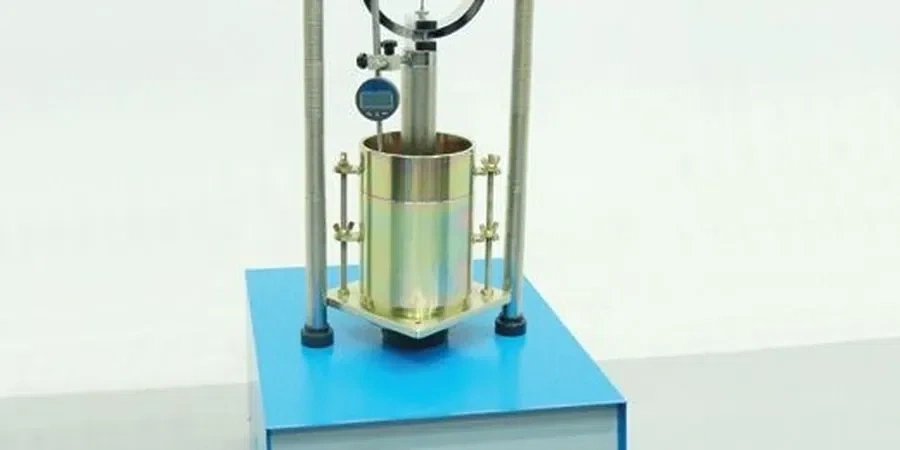
Maple Ridge sits between the Fraser River and the Coast Mountains, where annual rainfall exceeds 1,200 mm and much of the valley floor is underlain by compressible alluvial silts and pockets of glacial till. Designing a pavement or parking lot here without knowing the soaked bearing capacity of the subgrade is a gamble we see fail within two seasons. The laboratory CBR test gives us that number: a direct measurement of load-penetration resistance on a remolded or undisturbed specimen, conditioned to simulate the worst moisture scenario the road will face. Because the District’s engineering department reviews subgrade reports against the latest ASTM D1883 and AASHTO T-193 standards, we run every sample through a full four-day soak before the piston touches the surface. For projects where the native silt transitions into sandier lenses near the Albion flats, we often pair the CBR with a grain-size analysis to confirm fines content and anticipate drainage behavior under the pavement structure.
A soaked CBR below 3% on Maple Ridge silt means the pavement cross-section must change—no structural design can compensate for a subgrade that turns to slurry every winter.
Scope of work
Area-specific notes
Maple Ridge’s growth through the 1990s and 2000s pushed residential subdivisions onto low-lying terrain that had been bypassed by earlier development for a reason: the soils were soft. Several commercial pads built near Kanaka Creek in the early 2000s required full-depth reconstruction within eight years because the subgrade modulus assumed in the original design didn’t match the soaked CBR values that the saturated winter months imposed. The laboratory CBR test exposes that vulnerability before the asphalt goes down. We’ve measured CBR values below 1.5% in undisturbed organic silts taken from two metres depth; a pavement cross-section designed without that data will rut and crack within the first freeze-thaw cycle. The cost of a CBR test is measured in hundreds of dollars, while the cost of a failed subgrade runs into the hundreds of thousands once you factor in traffic management on Lougheed Highway or 224 Street. BC’s Ministry of Transportation and Infrastructure references the soaked CBR as a mandatory input for any flexible pavement design receiving provincial funding, and municipal reviewers expect the same level of rigor.
Standards used
ASTM D1883-21, AASHTO T-193-22, BC MoTI Supplement to TAC Guide
Linked services
Soaked CBR on subgrade soils
Full three-point compaction curve with 96-hour soak, penetration test, and swell measurement on native silts, clays, and tills from the project site.
CBR on imported granular borrow
Testing on sand and gravel borrow materials proposed for sub-base or capping layer, compacted at the specified moisture content and density target.
Moisture-density relationship (Proctor)
Standard or modified Proctor compaction test on the same material used for CBR, providing the reference density and optimum moisture for field compaction acceptance.
Pavement thickness design support
Interpretive report that converts laboratory CBR results into design subgrade modulus and recommends pavement cross-section options per the TAC Guide and BC MoTI requirements.
Typical parameters
Q&A
What’s the difference between a laboratory CBR and a field CBR test?
The laboratory CBR (ASTM D1883) is run on a remolded or undisturbed sample under controlled moisture and density conditions, including a four-day soak to simulate the worst-case saturated state. The field CBR is a penetration test performed directly on the compacted subgrade or base course using a similar plunger and loading frame. In Maple Ridge, where silty subgrades can lose 80% of their strength when saturated, the soaked laboratory value is the one that governs pavement design. The field test is useful for quality control during construction but does not replace the laboratory test for design purposes.
How much does a laboratory CBR test cost in Maple Ridge?
A single-point CBR test (one compaction effort) typically runs between CA$150 and CA$300, depending on the number of points requested and whether it’s bundled with a Proctor compaction test and grain-size analysis. Most pavement investigations require three CBR points per soil type to generate the complete moisture-density-CBR relationship, which puts a full suite in the CA$450 to CA$900 range per material. We provide a lump-sum quote upfront once we know how many distinct soil units need testing.
How long does it take to get CBR results?
The soaking period alone is 96 hours minimum per ASTM D1883. Add sample preparation, compaction, the penetration test, and reporting, and a standard turnaround is seven to eight working days from the date the sample arrives at the lab. If the project schedule is tight, we can run two sets of molds in parallel on different start dates so results roll out sequentially. Rush processing with overtime is available but must be arranged before the samples are submitted.
Can you test the CBR of material that’s already been compacted in the field?
Yes, we can run a laboratory CBR on an undisturbed block sample or a tube sample taken from a compacted lift, though it’s less common than remolded testing. The more practical approach for already-placed material is a field density test using the sand cone method, combined with a laboratory CBR on a remolded specimen compacted to the same density and moisture content. That gives you a defensible design CBR without the risk of sample disturbance during transport from Maple Ridge to the lab.