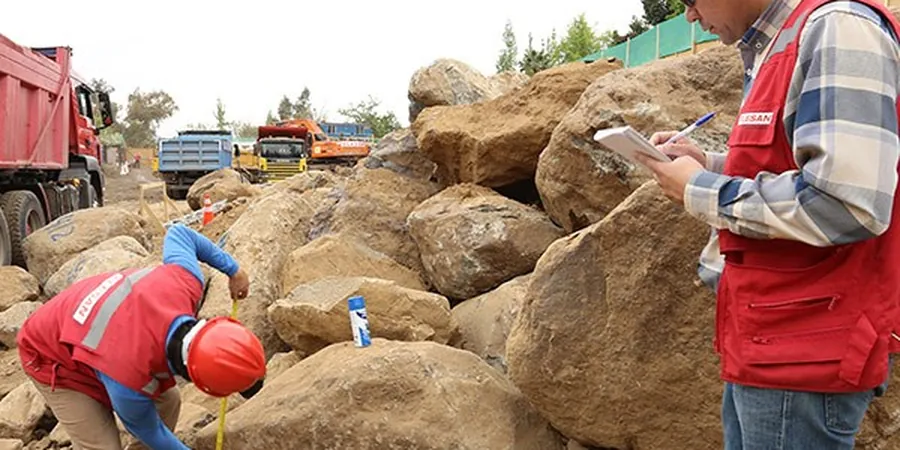
Maple Ridge sits on a complex mix of glacial till, silty floodplain deposits, and pockets of compressible organic soil along the Fraser River. A valley-side bench at about 300 m elevation means groundwater fluctuates with the seasons, complicating shallow foundation design. Our soil mechanics study gives you the numbers building officials and structural engineers actually need: shear strength parameters, consolidation settlement rates, and site-specific bearing capacity. We run every sample through our ISO 17025-accredited lab in the Lower Mainland. The work follows CSA + ASTM D2850 for triaxial and ASTM D4318 for Atterberg limits. Before site work begins, we often pair the investigation with test pits to map fill thickness across the property.
Maple Ridge foundations work hardest where the Fraser River floodplain transitions into upland till — our lab program captures both drained and undrained strength for that boundary.
Scope of work
Area-specific notes
Albion flats and the riverfront near Port Haney behave like two different cities underground. Albion has extensive soft clay lenses that lose strength when saturated; Port Haney sits on denser alluvial sand with better drainage but higher liquefaction potential during a Fraser Valley earthquake. A soil mechanics study that skips consolidation testing in Albion will underestimate settlement by half. In Port Haney, ignoring cyclic triaxial data means missing a liquefaction trigger that NBCC 2020 requires you to check. We sample at the depth intervals that match the planned foundation type — shallow footings get disturbed samples at 1.5 m spacing; deep piles get continuous sampling through the bearing stratum. Municipal building officials in Maple Ridge routinely ask for lab-validated friction angles and compressibility indices before issuing a permit.
Standards used
CSA + ASTM D2850 — Unconsolidated-Undrained Triaxial Compression, ASTM D4318 — Atterberg Limits, ASTM D698 — Standard Proctor, ASTM D6913 — Particle-Size Distribution (Sieve Analysis), NBCC 2020 — Structural Design, Section 4.2 Seismic
Linked services
Complete Soil Mechanics Laboratory Package
Moisture content, Atterberg limits, sieve and hydrometer analysis, Standard Proctor, and direct shear or UU triaxial. Each report includes USCS classification and tabulated design parameters ready for the structural engineer.
Consolidation and Settlement Analysis
One-dimensional consolidation testing per CSA + ASTM D2435 on Shelby tube samples. We calculate primary and secondary settlement for your proposed fill or foundation load, with e-log p curves and Cv values.
Typical parameters
Q&A
How much does a soil mechanics study cost for a single-family lot in Maple Ridge?
For a typical single-family lot in Maple Ridge, expect to invest between CA$4,170 and CA$6,290. The spread depends on access for the drill rig, number of boreholes, and whether we need to run consolidation or triaxial tests for soft silt layers. We provide a fixed-price proposal after reviewing the site plan.
Which lab tests does the District of Maple Ridge require for a building permit?
Building officials typically ask for grain-size distribution, Atterberg limits, and either direct shear or triaxial strength data. If your project is on the floodplain or near a watercourse, they often request consolidation parameters and a statement on groundwater conditions.
How long does lab testing take after the field samples arrive?
Standard classification and Proctor results are available in three to four working days. Triaxial and consolidation testing adds another five to seven working days because of specimen preparation and multi-stage loading schedules. We send preliminary data by email as soon as each test finishes.
Can you test for liquefaction potential in Maple Ridge?
Yes. We run cyclic triaxial or cyclic direct simple shear on undisturbed samples from the saturated sand layers found in the Port Haney and Albion areas. The results feed directly into the NBCC 2020 liquefaction assessment procedure using the NCEER simplified method.