The Fraser River floodplain and glacial uplands of Maple Ridge create a subsurface profile that shifts dramatically within a single site. One borehole hits dense till at 4 meters while the next, just 30 meters east, encounters 15 meters of compressible silts before refusal. This variability—shaped by the retreat of the Cordilleran ice sheet and subsequent Fraser River deposition—makes generalized bearing values useless here. SPT testing provides the point-specific N-values that structural engineers in Maple Ridge need to size footings, estimate settlement, and flag liquefiable layers before excavation begins. We run the split-spoon sampler per ASTM D1586-18 on every borehole, recording blow counts, recovery, and groundwater strikes in real time. For sites near the Alouette River or within the mapped liquefaction zones of the Maple Ridge Official Community Plan, we often pair SPT data with CPT soundings to cross-check thin silt seams that the 18-inch SPT interval can miss, and with grain-size analysis to confirm the fines content that controls cyclic resistance.
A hammer energy-calibrated N60 value removes the guesswork from liquefaction triggering—uncorrected blow counts in Maple Ridge silts can be off by 30 percent.
Scope of work
Area-specific notes
A 4-storey mixed-use building on Dewdney Trunk Road was designed with strip footings based on a desktop soil report that assumed 150 kPa bearing across the site. Three boreholes later, we found a buried organic silt lens at 2.5 meters—N-values of 2 to 4—directly beneath the proposed elevator core. The differential settlement across that 1.5-meter-thick layer would have exceeded 40 millimeters within the first two years. The structural engineer switched to a mat foundation with a rigid slab, bridging the weak pocket and keeping total settlement under 15 millimeters. Maple Ridge has too many paleochannels, abandoned oxbows, and peat pockets buried beneath clean fill to rely on regional mapping alone. An SPT refusal at shallow depth also triggers a different seismic site class determination under NBCC Table 4.1.8.4.A—miss that, and the design spectral acceleration can be underestimated by a full Site Class increment.
Standards used
ASTM D1586-18: Standard Test Method for Standard Penetration Test (SPT) and Split-Barrel Sampling of Soils, ASTM D4633: Standard Test Method for Energy Measurement for Dynamic Penetrometers, NBCC 2020, Table 4.1.8.4.A: Site Classification for Seismic Site Response, CSA A23.3: Design of Concrete Structures (foundation provisions), NCEER/Youd and Idriss 2001: Liquefaction Resistance of Soils
Linked services
SPT Borehole Drilling & Sampling
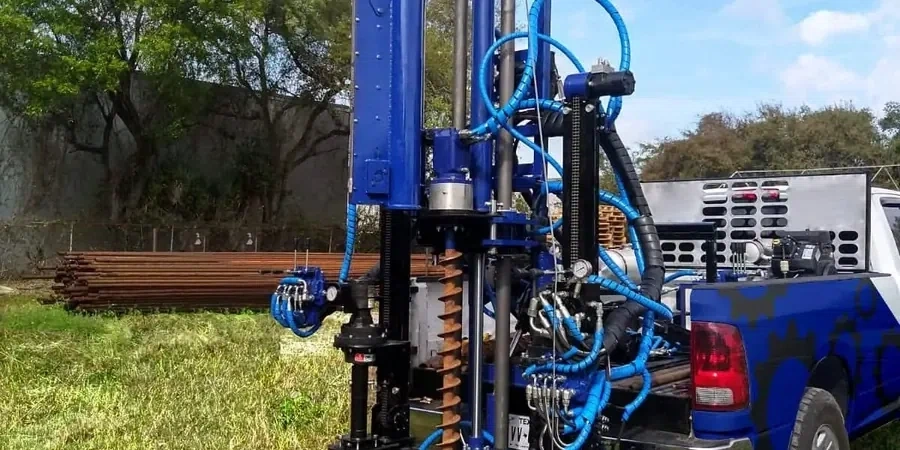
Track-mounted or skid-steer rig drilling to refusal or specified depth with automatic SPT hammer. Continuous split-spoon sampling at 1.5 m intervals, real-time N-value recording, and groundwater strike notation.
Liquefaction Triggering Analysis
N60-based evaluation using the NCEER/Youd and Idriss 2001 simplified procedure. We incorporate grain-size fines content and plasticity index from companion lab tests to refine cyclic resistance ratio estimates for Maple Ridge's alluvial deposits.
Seismic Site Classification (Vs30 Proxy)
Where SPT refusal depth permits, we estimate Vs30 from N-value correlations per NEHRP guidelines to assign NBCC Site Class. Combined with MASW when the building code requires direct Vs measurement for Class E or F confirmation.
Bearing Capacity & Settlement Estimates
Allowable bearing pressure calculations using Meyerhof or Terzaghi methods corrected for groundwater and footing embedment. Immediate and consolidation settlement predictions from SPT N-values, with recommendations for mat or deep foundations where needed.
Typical parameters
Q&A
How much does SPT drilling cost in Maple Ridge?
An SPT investigation in Maple Ridge runs CA$760 to CA$1,160 per borehole for standard 15-meter depth with automatic hammer, including field logging and N60 correction. Mobilization, traffic control on Lougheed Highway or Dewdney Trunk Road corridors, and lab testing of selected samples add to the total. Deep refusal or difficult access on steep escarpment lots may require a smaller track rig at a different rate.
How many SPT boreholes does NBCC require for a commercial building in Maple Ridge?
NBCC 2020 doesn't prescribe an exact number—it requires sufficient investigation to characterize subsurface variability. For a typical commercial lot in Maple Ridge's valley floor, we recommend a minimum of three boreholes to 15 meters or refusal, spaced to bracket the building footprint. The City may request additional points if the geotechnical report identifies liquefiable layers or organic soils beneath the proposed foundation elevation.
What's the difference between N-value and N60 in an SPT report?
Raw N-value is the blow count recorded in the field. N60 is that value corrected to a hammer energy ratio of 60 percent, accounting for the actual energy delivered by the specific hammer, rod length, sampler liner configuration, and borehole diameter. In Maple Ridge, where automatic trip hammers commonly deliver 75 to 85 percent of theoretical energy, using uncorrected N-values overestimates liquefaction resistance by 20 to 30 percent. Our reports always provide both raw N and N60.