Maple Ridge sits on a complex mix of glacial till, Fraser River deposits, and pockets of loose alluvial sand that can surprise even experienced contractors. When a recent subdivision off 232 Street encountered compressible silty sand at six meters, standard surcharge was going to take too long and shallow footings were ruled out. The solution required a vibrocompaction design approach that mapped the loose zones first, then defined probe spacing and vibration duration to achieve a target relative density above 70 percent across the entire building pad. Without this step, differential settlement becomes a real risk within the first five years. Our team applies the same methodical process whether the project is a tilt-up warehouse in Albion Flats or a pump station near the Alouette River, always starting with CPT data to calibrate the compaction grid. The goal is straightforward: turn heterogeneous loose deposits into a uniformly dense bearing layer that meets the NBCC 2020 performance criteria without over-compacting and wasting energy on already dense lenses.
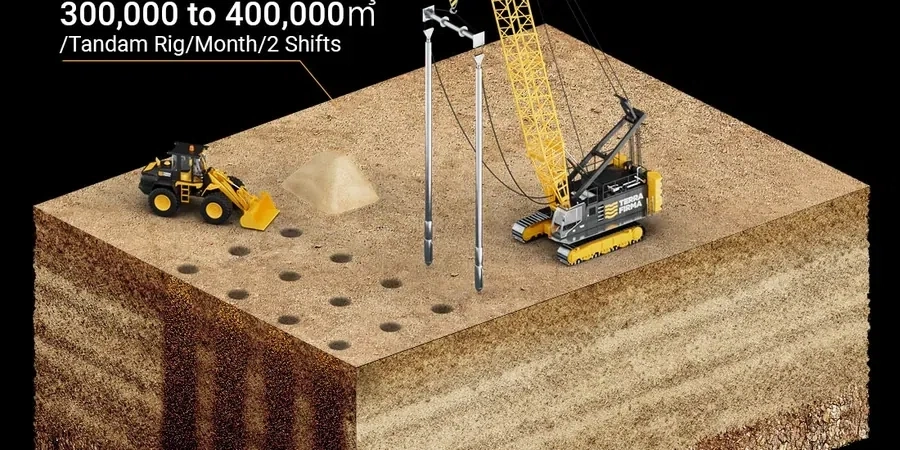
A well-designed vibrocompaction grid turns a compressible sand lens into a uniform bearing layer with relative density above 70 percent, verified by post-treatment CPT soundings.
Scope of work
Area-specific notes
The Fraser Valley's seismic setting adds urgency to vibrocompaction design in Maple Ridge. Loose saturated sands that would settle slowly under static load can liquefy within seconds during a moderate earthquake, and the city lies within a zone where NBCC 2020 demands explicit liquefaction assessment. A vibrocompaction design that ignores the water table fluctuations between March and October will misjudge the treatment energy needed; we have seen the water table rise nearly two meters from late summer to spring in some areas north of Lougheed Highway. That changes the effective stress and the vibrator's radius of influence. Undershooting the compaction energy leaves the soil vulnerable to pore pressure buildup during shaking, while overshooting it wastes fuel and can damage buried utilities. The design must also consider proximity to existing structures: vibration monitoring at adjacent foundations is standard practice when treating within 15 meters of an occupied building.
Watch how it works
Standards used
NBCC 2020 (National Building Code of Canada), CSA A23.3:19 (Design of Concrete Structures – geotechnical references), ASTM D6066-11 (Standard Practice for CPT for Liquefaction Assessment), ASTM D1586-18 (Standard Test Method for Standard Penetration Test), Youd & Idriss (2001) NCEER liquefaction resistance framework
Linked services
Grid design and probe layout optimization
We define probe spacing, penetration depth, and vibration duration based on CPT soundings and target density, balancing treatment uniformity with cost efficiency for your site geometry.
Pre- and post-treatment CPT verification
Direct measurement of tip resistance and friction ratio before and after vibrocompaction to quantify the density increase and confirm the design specification has been met.
Liquefaction mitigation compliance reports
Technical documentation demonstrating that the treated ground meets NBCC 2020 and local municipal requirements for seismic performance, ready for building permit submission.
Typical parameters
Q&A
What does vibrocompaction design cost in Maple Ridge?
For a typical Maple Ridge project, vibrocompaction design fees range from CA$2,170 to CA$7,250 depending on the treated area, depth of loose soils, and number of CPT verification soundings required. A small residential lot with a single test panel falls at the lower end; a commercial site needing multiple grid refinements and a full post-treatment CPT campaign reaches the upper range.
How deep can vibrocompaction densify loose soil?
Standard electric and hydraulic vibrators reach 25 to 35 meters in favorable conditions. In Maple Ridge, most loose deposits requiring treatment sit within the upper 15 meters, but we have designed grids for deeper alluvial fills where the Fraser River paleochannel extends below 20 meters.
How do you verify the ground has been densified enough?
We run CPT soundings at the same locations before and after treatment and compare tip resistance profiles. A relative density above 70 percent is the typical acceptance criterion, and we often add shear wave velocity measurements for liquefaction-sensitive sites.
Can vibrocompaction be used near existing buildings?
Yes, but with vibration monitoring. When treating within 15 meters of an occupied structure in Maple Ridge, we specify lower initial vibration energy and monitor peak particle velocity at the foundation. The design may switch to a smaller probe or offset the grid to protect sensitive utilities.