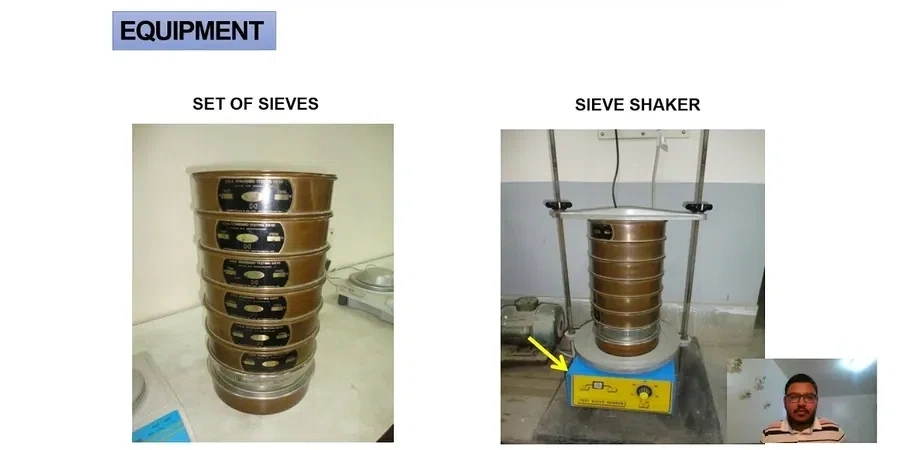
Last spring, a contractor in East Maple Ridge got stopped cold by the city inspector over fill material that didn’t drain. The root cause wasn’t bad gravel — it was a missing grain size curve. A sieve plus hydrometer analysis costs less than a day of idled equipment, yet we still see projects delayed because someone decided to skip it. Here, where the Fraser River has laid down layers of silt and fine sand over glacial till, you can’t rely on what the material looks like. Our lab runs the full stack — CSA + ASTM D422 and D6913 — and we’ve done it for dozens of subdivisions, road widenings, and retaining wall backfills across Maple Ridge. We often pair it with a Proctor test when compaction control is part of the spec, because knowing the gradation without the moisture–density relationship leaves half the picture blank.
A 2-micron fraction can control whether your backfill drains or holds water — that’s why the hydrometer matters.
Scope of work
Area-specific notes
Maple Ridge sits at roughly 50 m elevation near the dikes and climbs toward 300 m up in Silver Valley — and the soil story changes with every contour. The Fraser River floodplain brings soft, compressible silts; the uplands bring stony glacial till. If you misclassify a silty sand as a clean sand, you risk underestimating settlement or overestimating drainage capacity. We’ve pulled soil reports where a single sieve stack without hydrometer gave a totally misleading fines content, and the foundation drain design had to be re-done after the first wet winter. Seismic performance adds another layer: the NBCC 2020 site classification depends on shear-wave velocity and soil type, and fines content directly affects liquefaction susceptibility. A grain size analysis that stops at No. 200 is essentially blind to the behavior of the soil mass under cyclic loading. For any project within the District of Maple Ridge’s floodplain review area, the hydrometer is not optional — it’s the difference between a permit that moves and one that gets stuck.
Standards used
CSA + ASTM D422(2007)e2 — Standard Test Method for Particle-Size Analysis of Soils, ASTM D6913/D6913M-17 — Particle-Size Distribution (Gradation) of Soils Using Sieve Analysis, ASTM D2487-17e1 — Standard Practice for Classification of Soils for Engineering Purposes (USCS), ASTM D7928-21 — Standard Test Method for Particle-Size Distribution (Gradation) of Fine-Grained Soils Using the Sedimentation (Hydrometer) Analysis
Linked services
Full Sieve + Hydrometer Package
CSA + ASTM D422 and D6913 combined, covering 75 mm down to 2 µm. Includes USCS classification and the complete particle-size distribution curve.
Sieve-Only Analysis (Coarse Fraction)
ASTM D6913 from 75 mm to No. 200. Suitable for clean sands and gravels where the fines fraction is confirmed below 5%.
Gradation with Atterberg Limits
Pair grain size data with liquid and plastic limits for full USCS classification of silts and clays encountered in Maple Ridge foundation excavations.
Typical parameters
Q&A
How much does a grain size analysis with hydrometer cost in Maple Ridge?
For a standard sieve-plus-hydrometer package following CSA + ASTM D422 and D6913, plan on CA$130 to CA$270 depending on sample preparation and whether a full USCS classification report is included. Rush turnaround adds a small surcharge.
When does a project need a hydrometer instead of just a sieve analysis?
Any time the material passing the No. 200 sieve exceeds 5%, or when drainage, frost susceptibility, or liquefaction potential are design factors. In Maple Ridge's floodplain silts and upland tills, skipping the hydrometer often leads to misclassified soil and drainage failures.
How soon do I get lab results for a grain size analysis?
Our standard turnaround is three to four working days from sample receipt. For time-sensitive projects in Maple Ridge — like a footing inspection that depends on backfill approval — we can deliver results in 48 hours with prior arrangement.