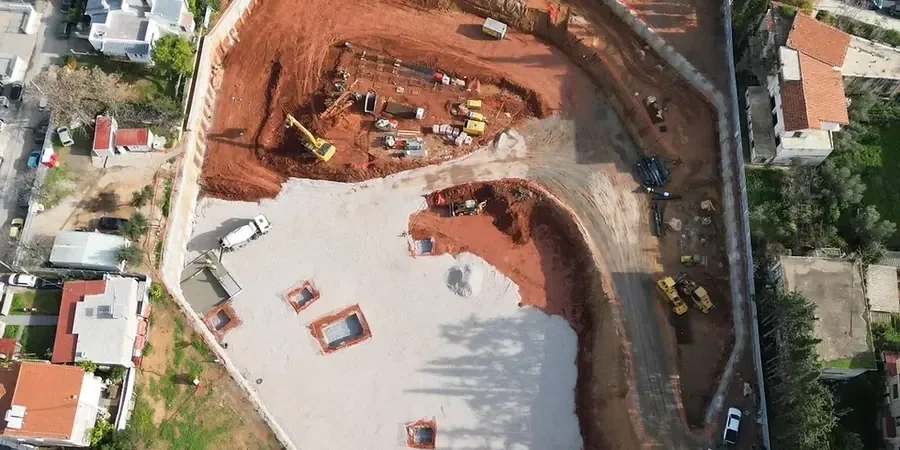
Maple Ridge sits at roughly 50 meters above sea level, straddling the transition between the Fraser River floodplain and the upland glacial deposits of the Golden Ears foothills. This elevation shift matters when you excavate: a site on 224 Street can hit dense till within three meters, while a lot near the Alouette River encounters loose alluvial sands and high groundwater at less than two meters depth. Deep excavation design here is not a copy-paste exercise. Our geotechnical laboratory runs the index and strength tests that feed directly into shoring wall analysis, tieback bond length calculations, and base heave checks. For excavations exceeding 4.5 meters, the slope stability parameters we derive from consolidated-undrained triaxial testing on undisturbed Shelby tube samples become critical inputs to the overall wall design.
Stiff Vashon till can support near-vertical cuts temporarily, but relaxation cracks and perched groundwater turn a stable face into a hazard within hours of exposure.
Scope of work
Area-specific notes
Maple Ridge expanded significantly after the Lougheed Highway was upgraded in the 1980s, pushing residential subdivisions into areas underlain by deeply weathered bedrock and ancient landslide debris. Deep excavations in these zones can daylight pre-existing shear surfaces that were dormant for centuries. The risk is not theoretical: a 2017 basement dig on a slope above Kanaka Creek triggered a small rotational slide that took six months to remediate. Our approach layers site-specific laboratory strength data with observational method protocols. We test for residual friction angle on polished slickensided samples from the site, then define a lower-bound strength envelope for the shoring designer. This prevents the use of peak strength values that overestimate the soil's ability to stand open, especially when the excavation remains unsupported through a wet November weekend.
Standards used
NBCC 2020 Part 4 — Structural Design, CSA A23.3-19 — Design of Concrete Structures, ASTM D4767-11 — Consolidated Undrained Triaxial Compression Test for Cohesive Soils, ASTM D2488-17 — Visual-Manual Description of Soils, FHWA GEC No. 2 — Earth Retaining Structures (reference)
Linked services
Shoring Wall Design Parameters
Laboratory determination of drained and undrained strength for soldier pile, secant pile, and diaphragm wall analysis. Includes CIU triaxial with pore pressure measurement and oedometer tests for consolidation settlement behind the wall.
Tieback Anchor Bond Zone Evaluation
Direct shear testing on reconstituted samples at target grouting depths to establish ultimate bond stress values. We test both the dense till and the underlying fractured bedrock to optimize anchor free and bond lengths.
Base Heave and Piping Assessment
Permeability testing (falling-head and constant-head flexible-wall) on undisturbed samples from below the excavation subgrade. Combined with critical gradient calculations to specify dewatering and toe embedment requirements.
Typical parameters
Q&A
How do you determine the soil parameters for a deep excavation in Maple Ridge's glacial soils?
We retrieve thin-wall Shelby tube samples from the proposed wall alignment at multiple depths. In the lab, we run CIU triaxial tests to get effective stress friction angle and cohesion, oedometer consolidation tests for stiffness, and Atterberg limits for classification. The data package includes stress-strain curves and pore pressure response so the structural engineer can model the excavation sequence with hard numbers rather than textbook defaults.
What does a deep excavation geotechnical design package cost in Maple Ridge?
A complete laboratory testing and parameter derivation package for a typical single-family basement excavation generally falls between CA$3.260 and CA$5.700, while a multi-level commercial shoring design with tieback bond evaluation and base heave analysis ranges from CA$7.800 to CA$11.070, depending on the number of boreholes and the laboratory tests required to characterize the ground profile.
Can you test for the risk of bottom heave in a deep excavation?
Yes. We measure the undrained shear strength of the clay below the excavation subgrade through UU triaxial or Torvane on recovered samples, then calculate the factor of safety against base heave using bearing capacity methods. If a low factor is predicted, we can also run swell-consolidation tests to evaluate how the clay will rebound when the overburden is removed, so the contractor can plan for staged excavation and rapid slab placement.