Maple Ridge sits on a thick sequence of glacial till and outwash sands deposited by the retreating Fraser Glaciation, a foundation legacy that shapes every excavation and retaining structure north of the Fraser River. Over the past two decades, the shift from low-rise commercial to mid-rise mixed-use along the Lougheed Highway corridor has pushed foundation engineering into new territory, where temporary shoring and permanent tied-back walls are no longer an exception. Understanding the difference between an active anchor, which is tensioned to pre-compress the ground, and a passive bar that mobilizes resistance only after ground movement begins, becomes critical when you are working within 10 meters of a neighboring property. Our team's experience with soil anchor design in Maple Ridge is built on correlating borehole data with actual performance during proof testing. For projects with deep cuts in loose granular layers, we often combine anchor design with a slope stability analysis to verify global factors of safety before any tendon is installed.
In Maple Ridge's glacial stratigraphy, the difference between an active and passive anchor system is often the difference between a millimeter of lateral movement and a costly neighbor dispute.
Scope of work
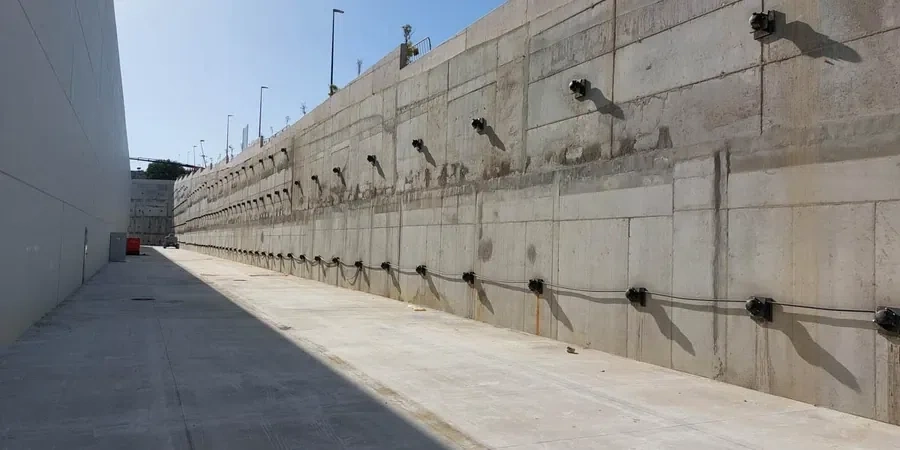
Area-specific notes
A 2019 geological survey by the BC Ministry of Energy and Mines mapped the Maple Ridge area as underlain by up to 30 meters of Vashon Drift, a dense basal till that is often overlain by softer advance glaciolacustrine silts. The risk of not performing site-specific anchor testing is that bond stress values assumed from the PTI manual can overestimate capacity by 30 percent in these silts, leading to creep failure under sustained load. Another hazard specific to the high groundwater table along the Kanaka Creek corridor is hydrostatic pressure buildup behind a wall, which can increase the tension demand on passive anchors beyond the original design envelope. We have also observed that the cobble-rich lodgement till near the Golden Ears foothills deflects small-diameter drill bits, making it difficult to achieve the required bond zone alignment without a pilot hole. A thorough pre-production test program, usually involving three to five sacrificial anchors, eliminates these uncertainties before production drilling begins.
Standards used
CSA A23.3-19 Annex D — Anchorage to Concrete and Rock, PTI DC35.1-14 — Recommendations for Prestressed Rock and Soil Anchors, ASTM A416/A416M-18 — Standard Specification for Low-Relaxation, Seven-Wire Steel Strand for Prestressed Concrete, NBCC 2020 Division B, Part 4 — Structural Design for Seismic Loads
Linked services
Pre-Production Anchor Testing and Design Validation
We install sacrificial test anchors in the exact soil units that will carry the working load, pulling each tendon to 133 percent of the design load while monitoring creep with a dial gauge and digital load cell. The resulting bond stress values are used to adjust bonded lengths before production drilling begins.
Corrosion Risk Assessment and Protection Specification
Using soil resistivity measurements and groundwater pH data from the site, we classify the aggressivity of the ground and specify the appropriate protection level, from single encapsulated strand in low-risk conditions to full double corrosion protection with factory-grouted sheath for permanent installations near the Fraser River floodplain.
Typical parameters
Q&A
What is the difference between an active anchor and a passive anchor in retaining wall design?
An active anchor is tensioned with a hydraulic jack to a specified lock-off load before the excavation proceeds, actively compressing the soil mass and limiting lateral movement from the start. A passive anchor, typically a grouted threadbar, is not tensioned and only develops resistance once the wall begins to deflect and the ground deforms. In Maple Ridge, where adjacent structures are often close, active anchors are preferred for cuts deeper than six meters to keep lateral displacement below 25 millimeters.
How much does anchor design and testing cost for a typical Maple Ridge project?
For a mid-size tied-back wall with 20 to 40 anchors, the combined cost of design, pre-production testing, and construction-phase load testing typically falls between CA$1,360 and CA$4,510 per anchor, depending on whether the system is temporary or permanent, the corrosion protection level required, and the accessibility of the drilling rig.
What is the typical bonded length for a soil anchor in the glacial till found around Maple Ridge?
In the dense Vashon Drift till that underlies much of Maple Ridge, bonded lengths typically range from 6 to 12 meters for working loads between 200 and 800 kN. The exact length is determined by the results of pre-production pull-out tests, because the till's matrix content can vary significantly within a single site, affecting the grout-to-soil bond strength.
How do you verify that an installed anchor meets its design capacity?
Every anchor undergoes a proof test where the tendon is stressed to 133 percent of the design load and held for 60 minutes while creep is monitored. The acceptance criterion is typically less than 2.0 millimeters of movement during the hold period. In Maple Ridge, we also perform lift-off tests on 10 percent of production anchors after lock-off to verify that the residual load has not dropped below 100 percent of the design value.