Designing a retaining wall in Maple Ridge demands a clear understanding of the local ground conditions, which can vary significantly between the upland bench areas and the floodplain near the Fraser River. A wall founded on the dense glacial till of Silver Valley presents a fundamentally different engineering challenge than one retaining the soft, compressible silts and clays along the Alouette River corridor. Our team approaches each project by first characterizing the subsurface profile through targeted investigation, ensuring the retaining wall design accounts for bearing capacity, global stability, and long-term drainage conditions specific to the site. For walls exceeding 1.2 meters in height or supporting surcharge loads from adjacent structures, we integrate the findings from a slope stability analysis to verify that the proposed geometry does not introduce a deeper-seated failure risk, a common concern on Maple Ridge's sloping terrain.
A retaining wall is only as reliable as the soil it retains; in Maple Ridge, designing for drainage is as critical as designing for bending moment.
Scope of work
Area-specific notes
The National Building Code of Canada (NBCC 2020) mandates seismic design considerations that are particularly relevant for Maple Ridge, given the city's proximity to the Cascadia Subduction Zone and local crustal faults. A retaining wall here must be analyzed not only for static earth pressures but also for the incremental dynamic thrust induced during a design-level earthquake. The often-neglected risk lies in the liquefaction potential of loose, saturated sandy lenses within the alluvial deposits south of Lougheed Highway; a retaining wall founded on or retaining such material can experience excessive lateral movement or bearing failure during a seismic event if this condition is not identified and mitigated. Our design protocol explicitly evaluates post-earthquake serviceability, ensuring that critical walls maintain functionality when they are needed most.
Standards used
NBCC 2020 (National Building Code of Canada), CSA A23.3:19 (Design of Concrete Structures), ASTM D3080/D3080M (Direct Shear Test of Soils), CFEM (Canadian Foundation Engineering Manual, 4th Ed.), AASHTO LRFD Bridge Design Specifications (9th Ed., for MSE walls)
Linked services
Gravity & Cantilever Wall Design
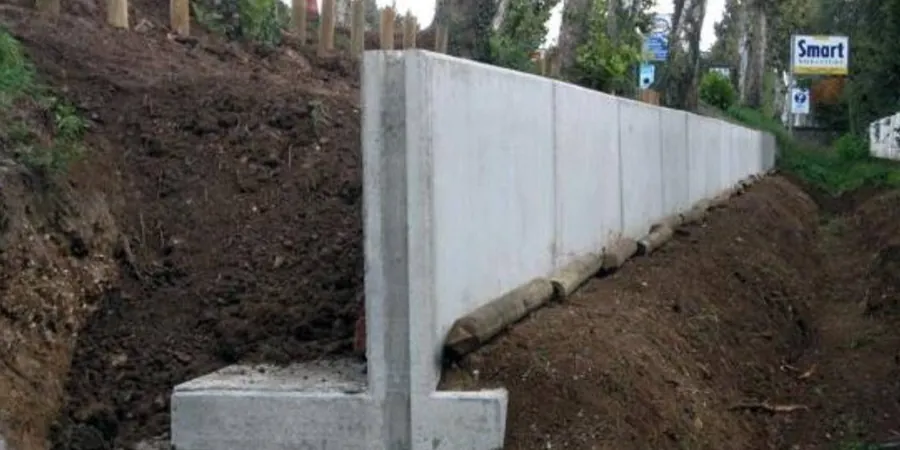
We provide complete structural design for reinforced concrete cantilever walls and gravity systems using cast-in-place concrete or segmental blocks. Our design calculations verify both internal stability (stem bending, heel/toe shear) and external stability (sliding, overturning, bearing capacity) under static and seismic load combinations per NBCC 2020.
Mechanically Stabilized Earth (MSE) Walls
For applications where vertical cuts exceed 4 meters or where differential settlement is a concern, we design MSE walls using geogrid or steel strip reinforcement. This includes pullout resistance verification and global compound stability analysis, which is critical on the sloping terrain found in northern Maple Ridge neighborhoods.
Temporary Shoring & Excavation Support
For deep excavations adjacent to existing structures or public rights-of-way, we design soldier pile and lagging walls, sheet piles, or soil nail systems. Our team prepares engineered shoring plans that meet WorkSafeBC Part 20 requirements, ensuring worker safety and adjacent property protection throughout construction.
Typical parameters
Q&A
What is the typical cost for retaining wall design in Maple Ridge?
Retaining wall design fees in Maple Ridge generally range from CA$1,500 to CA$5,250 depending on wall height, complexity, and the required level of geotechnical investigation. A straightforward gravity wall under 1.5 meters often falls toward the lower end, while an engineered cantilever or MSE wall exceeding 3 meters, requiring stamped structural drawings and a site-specific seismic analysis, will be at the higher end due to the additional calculation and detailing effort.
Do I need a building permit for a retaining wall in Maple Ridge?
The District of Maple Ridge typically requires a building permit for retaining walls exceeding 1.2 meters (4 feet) in height, measured from the bottom of the footing to the top of the wall. Walls supporting a surcharge, such as a driveway or building foundation, or walls located near property lines may require an engineered design and a schedule B professional commitment regardless of height.
How do you account for the high rainfall in Maple Ridge when designing a retaining wall?
With Maple Ridge receiving over 1,800 mm of annual precipitation, hydrostatic pressure is a dominant design consideration. We specify a continuous drainage system behind the wall—typically a 300 mm thick free-draining granular backfill separated from native soil by a non-woven geotextile filter, combined with a perforated weeping tile at the base—to prevent the buildup of water pressure that can cause wall failure. For silty backfill materials, we often increase the drainage capacity and include redundant weep holes spaced at 1.5 meters on center.