ASTM D698 and D1557 define the moisture-density relationship that governs compaction acceptance on every civil project in Maple Ridge. The city’s surficial geology shifts from Sumas Drift to post-glacial alluvium along the Fraser River, so a single maximum dry density assumption creates risk across a subdivision. We run standard and modified Proctor tests in our ISO 17025-accredited lab, delivering curves that match the actual borrow material on site. For roadway subgrade along the Lougheed Highway corridor, we often pair Proctor data with sand cone density field checks to verify 95% modified Proctor compaction, while trench backfill in Silver Valley requires careful moisture conditioning when the fines content climbs above 12%. The result is a defensible compaction specification, not a generic number from a textbook.
A 1% deviation in moisture content can cost you 5% of dry density. In Maple Ridge’s variable tills, that margin separates a passing lift from a failed one.
Scope of work
Area-specific notes
Maple Ridge’s north side sits on dense Sumas Drift with high bearing capacity, while the riverfront near Port Haney is underlain by compressible alluvial silts that lose strength when recompacted at the wrong moisture content. The risk shows up when a single Proctor reference is applied across both zones. Over-compaction in the silty Fraser floodplain can induce pore pressure and shear failure, while under-compaction in the till leaves settlement-prone fill. We’ve seen subdivision roads in Albion require rework because the imported structural fill was compacted dry-of-optimum, leading to collapse upon wetting. Our approach mandates material-specific Proctor curves for each distinct borrow source and field verification with a nuclear density gauge or sand cone. This closes the loop between lab optimum and field density, keeping the compaction specification enforceable under the BC Building Code and MMCD standards.
Watch how it works
Standards used
ASTM D698-12: Standard Test Methods for Laboratory Compaction Characteristics of Soil Using Standard Effort, ASTM D1557-12: Modified Proctor Test, BC Ministry of Transportation MMCD – Section 31 23 33 (Earthwork), ASTM D4718-15: Oversize Correction
Linked services
Standard Proctor (ASTM D698)
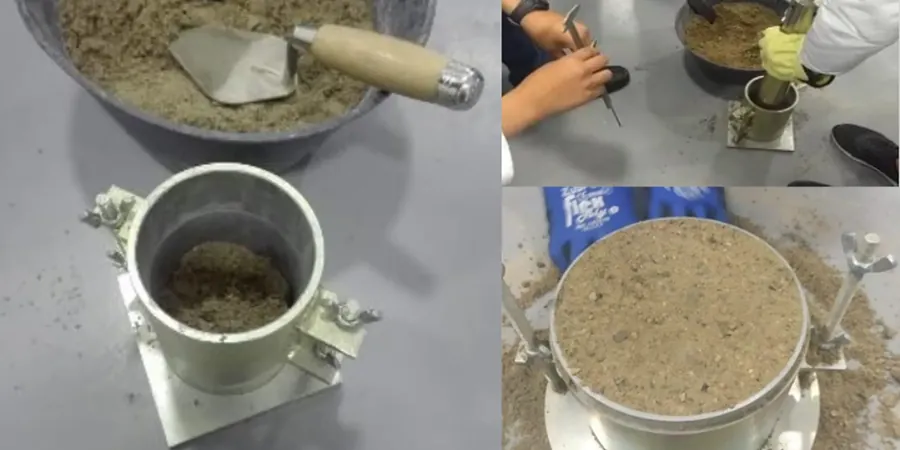
Four-inch or six-inch mold, three layers, 25 blows per layer. We determine the maximum dry density and optimum moisture content for fine-grained soils and sand-clay mixtures. This test governs backfill compaction for residential lot grading, landscaping, and shallow utility trenches in Maple Ridge subdivisions.
Modified Proctor (ASTM D1557)
Five layers, 25 or 56 blows per layer using the 10-lb hammer. We apply this higher compactive effort for road subgrade, structural fill under footings, and engineered embankments. The curve includes zero-air-voids and saturation lines, with oversize correction per ASTM D4718 when gravel content exceeds 20%.
Typical parameters
Q&A
How much does a Proctor test cost in Maple Ridge?
A standard Proctor (ASTM D698) typically runs between CA$140 and CA$220 per sample, while a modified Proctor (ASTM D1557) ranges from CA$190 to CA$310 depending on mold size and whether oversize correction is needed. We provide a firm quote once we know the number of borrow sources and the expected gravel fraction.
How many Proctor samples do I need for my subdivision project?
At least one Proctor per distinct borrow source or per 5000 m³ of placed fill, whichever is more frequent. In Maple Ridge, where borrow material can change between the Sumas Drift uplands and the Fraser alluvium, we recommend running a new five-point curve whenever the visual classification or gradation shifts. For trench backfill, we often use one-point Proctor checks between full curves to confirm consistency.
How long does it take to get Proctor test results?
A standard turnaround is two to three working days from sample drop-off to the signed report. We can expedite to 24 hours for active earthworks where compaction is on hold. The report includes the compaction curve, zero-air-voids line, optimum moisture, maximum dry density, and specific gravity, ready for the geotechnical engineer’s review.