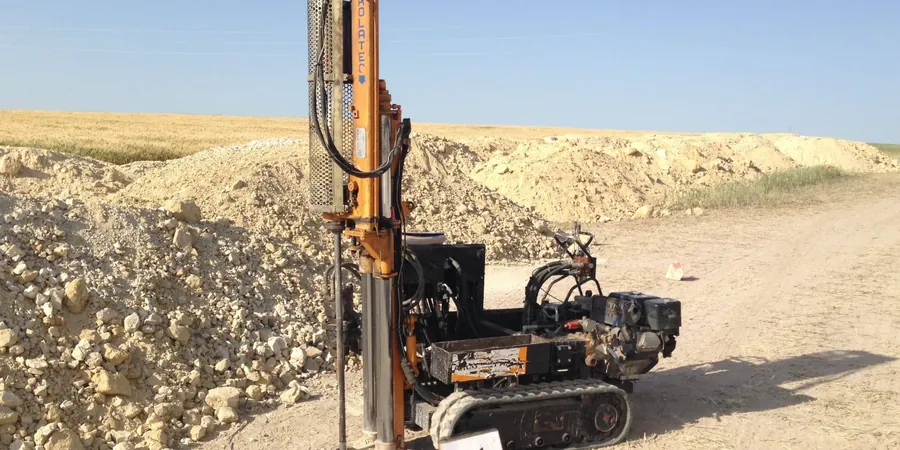
The hydraulic behavior of subsurface soils in Maple Ridge changes drastically within a few hundred meters. You might encounter dense glacial till near the Golden Ears foothills giving way to highly permeable Fraser River outwash sands along Dewdney Trunk Road. A standard lab test on a small sample simply cannot capture the connectivity of these natural drainage paths. For groundwater control during excavation or assessing seepage under a proposed foundation, direct measurement of hydraulic conductivity becomes the only reliable benchmark. The Lefranc test handles this in soil, while the Lugeon test applies to fractured bedrock—both executed in the same boreholes we use for SPT drilling, thereby maximizing the data you get from each drilled meter.
A single Lugeon value from a fractured granodiorite borehole tells you more about potential grout consumption than a dozen lab porosity tests.
Scope of work
Area-specific notes
The contrast between the well-draining gravel terraces of Albion and the tighter, glacially overridden silts of Thornhill creates distinct risk profiles for the same construction method. In Albion, a simple foundation excavation can intercept a high-yield perched aquifer, leading to rapid base softening if the hydraulic conductivity is underestimated. In Thornhill, low-permeability soils might suggest dry digging, but residual pore pressures from seasonal saturation can cause delayed slope failures if drainage is not actively managed. Relying on textbook permeability values without localized field pumping tests in Maple Ridge often results in undersized sump pumps, extended construction delays during the rainy winter months, and cost overruns on dewatering contracts that were bid too optimistically based on desk studies alone.
Standards used
ASTM D6391-11 (Standard Test Method for Field Measurement of Hydraulic Conductivity Using Borehole Infiltration), Houlsby, A.C. (1976) - Routine interpretation of the Lugeon water-test, CSA A23.3 (Design of concrete structures - related dewatering provisions)
Linked services
Borehole Lefranc Testing
Constant and falling head tests executed in soil boreholes immediately after drilling to minimize smearing effects. We isolate specific lithological units identified in the log to build a vertical conductivity profile.
Lugeon Packer Testing in Rock
Multi-pressure stage testing in bedrock to assess fracture connectivity and groutability. The Lugeon pattern (laminar, turbulent, dilation, wash-out) guides curtain grouting design for cut-off walls.
Dewatering Feasibility Assessment
Combines field permeability data with groundwater level monitoring to calculate sustainable pumping rates, radius of influence, and settlement risk for adjacent structures during construction dewatering.
Typical parameters
Q&A
When is a field permeability test required instead of a lab test in Maple Ridge?
Field tests are mandated when undisturbed sampling is impossible—very common in the clean sands and gravels of the Maple Ridge uplands. Lab tests on remolded samples fail to preserve macro-structures like root holes and gravel lenses. Any project requiring a dewatering plan approved by the City of Maple Ridge engineering department will almost certainly need field-measured conductivity values.
What is the typical cost range for a Lefranc or Lugeon test program?
For a standard investigation in the Maple Ridge area, a field permeability test program typically ranges from CA$880 to CA$1,560 per test interval, depending on depth, access constraints, and the number of pressure stages required. A full-day program with multiple test intervals provides the most cost-efficient approach for larger projects.
How long does a single Lefranc test take?
A single constant-head Lefranc test usually requires 30 to 60 minutes of steady-state flow measurement after the test zone has been saturated and stabilized. The total time per interval, including packer setting and borehole preparation, averages about 90 minutes in the silty sand formations common to the Fraser Valley.
Can you perform these tests in cased boreholes?
Yes, we routinely test through hollow-stem augers or temporary steel casings. The test section is isolated below the casing bottom using pneumatic packers. This is standard practice in Maple Ridge's cobbly glacial till, where uncased holes would collapse before the test could be completed safely.