Raft foundation design in Maple Ridge requires strict adherence to the National Building Code of Canada (NBCC 2020) and CSA A23.3, particularly when dealing with the compressible alluvial and glacial deposits that dominate the Fraser River lowlands. The city sits at roughly 50 m elevation, but the soil profile can change dramatically within a single lot—from dense till to soft silts—making differential settlement the primary design challenge. A uniform-thickness slab isn't enough. Our team performs detailed subgrade reaction modulus (kₛ) evaluation to model soil-structure interaction, integrating the test pits data with elastic settlement theory before defining the mat geometry. This approach prevents the cracking and serviceability failures we've observed in under-designed slabs across the Lower Mainland.
A properly designed raft foundation on soft Maple Ridge soils doesn't just support the structure—it averages out the differential settlement that would otherwise tear a building apart.
Scope of work
Area-specific notes
The geotechnical contrast between the higher, gravelly terraces of Silver Valley and the low-lying silty clays near the Pitt River is stark. A building in Silver Valley might sit on dense Sumas Drift with negligible settlement, while a few kilometers south, the same structural load on Fraser River sediments could settle 40 mm or more. Ignoring this variability is the most common cause of foundation distress we see. A raft foundation mitigates this by stiffening the entire footprint, but it demands a detailed stratigraphic model. We run 3D finite element settlement analysis using Plaxis or Settle3 to verify that the angular distortion stays within the 1/500 limit specified in NBCC Commentary C, preventing drywall cracks and door frame racking that plague under-engineered slabs in this region.
Standards used
NBCC 2020 (Division B, Part 4), CSA A23.3:19 - Design of Concrete Structures, ASTM D1195/D1196 - Repetitive/Static Plate Load Tests for kₛ
Linked services
Subgrade Investigation & kₛ Determination
We combine SPT, CPT, and plate load test data to derive the modulus of subgrade reaction. This isn't a textbook value—it's calibrated to the specific soil layering at your Maple Ridge site.
Raft Structural Design & Detailing
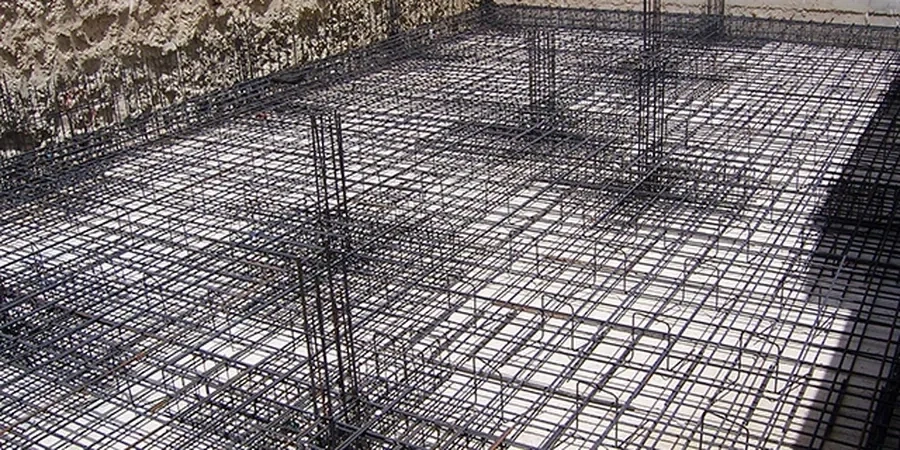
Full mat design per CSA A23.3, including flexure, one-way and two-way shear, and reinforcement scheduling. We handle irregular column grids and point loads from shear walls.
Settlement & Soil-Structure Interaction Analysis
Using 3D numerical modeling, we predict total and differential settlement under long-term dead plus live loads, ensuring your structure meets NBCC serviceability criteria from day one.
Typical parameters
Q&A
What is the typical cost for a raft foundation design in Maple Ridge?
Fees generally range from CA$1,600 to CA$5,200 depending on footprint size, number of point loads, and the complexity of the soil profile. A straightforward residential mat on competent till sits at the lower end, while a multi-story building on compressible soils requiring 3D settlement analysis falls in the upper range.
When is a raft foundation better than isolated footings in Maple Ridge?
When the allowable bearing pressure is below 100 kPa, or when the predicted differential settlement between adjacent footings exceeds 12 mm. Rafts also excel where the water table is high, and individual deep footings would require extensive dewatering.
Does the NBCC require a specific settlement analysis for mat foundations?
NBCC 2020 Commentary C specifies a 1/500 angular distortion limit for conventional structures, which effectively mandates a serviceability limit state check. We perform this using both analytical methods (such as the Winkler model) and numerical modeling for irregular load patterns.
How long does the design and approval process take?
From completing the geotechnical field investigation to delivering signed, sealed structural drawings, expect two to three weeks. Municipal review timelines in Maple Ridge vary, but our packages are formatted to District of Maple Ridge standards to expedite permit issuance.